> For the complete documentation index, see [llms.txt](https://docs.truvera.io/llms.txt). Markdown versions of documentation pages are available by appending `.md` to page URLs; this page is available as [Markdown](https://docs.truvera.io/credential-wallet/white-label-wallet/publishing-in-app-stores/android-build-testing-and-publishing.md). Agents can also search and read this documentation through its [MCP server](https://docs.truvera.io/~gitbook/mcp).
# Android build testing and publishing
## Configuration phase
1. When the customizations are done and repository updated create a Pull Request (PR)
2. Truvera will review and merge the PR into the master branch. That will trigger a new build. This will usually take \~1-2 business days.
3. A new release will be created in the distribution repository
* release name will be: wallet-version + wallet-build-number e.g: **v0.4.5\_build-523**
* If only minor changes are made on the whitelabel wallet they will be uploaded to an existing release instead of creating a new one to keep consistency with the Truvera Wallet.
4. Assets will be uploaded to the release in the ../releases
## Testing phase
### Testing with direct apk installation:
1. Download the .apk file from the release
2. Install the wallet on an android phone
3. Test the wallet to see if any changes are needed
### Testing with Google Play internal testing tool
1. Download the .aab file from the release
2. Create a new internal testing release
3. Upload the .aab file
4. The app will be reviewed by Google
5. After the review you can add internal testers (email address) that will be able to download the app from the stores.
## Publishing phase
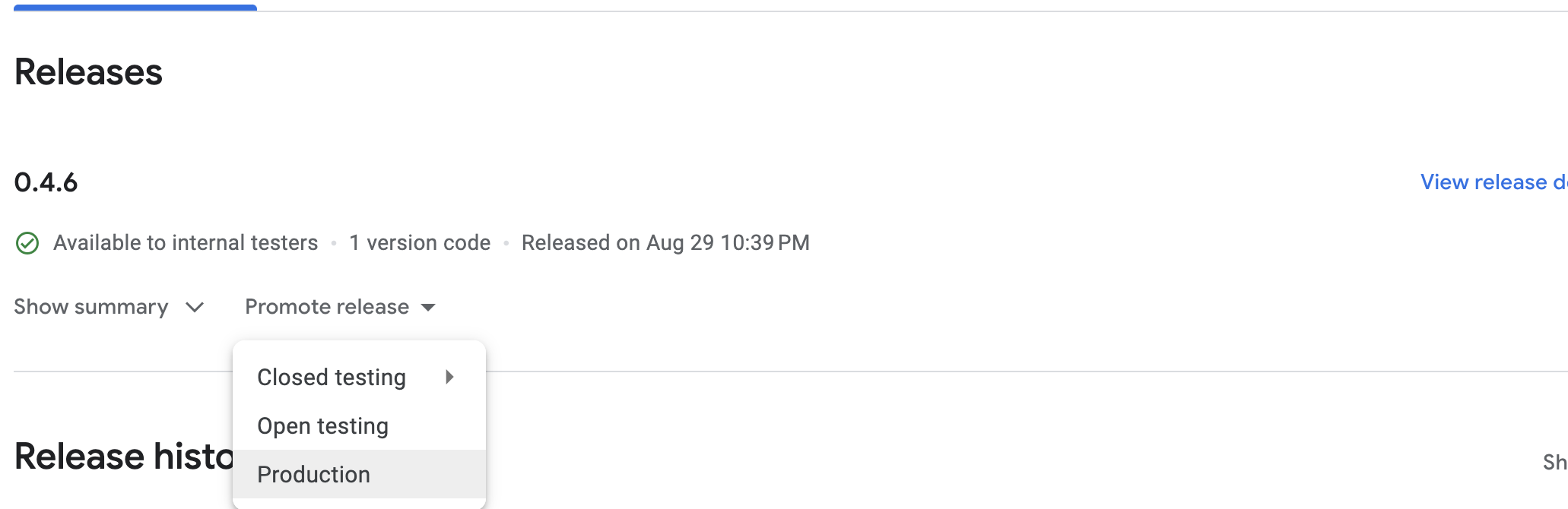
1. After the internal testing is done and no more changes are needed you can promote internal testing build to production.
2. Once you promote the build to production, Google will review the app
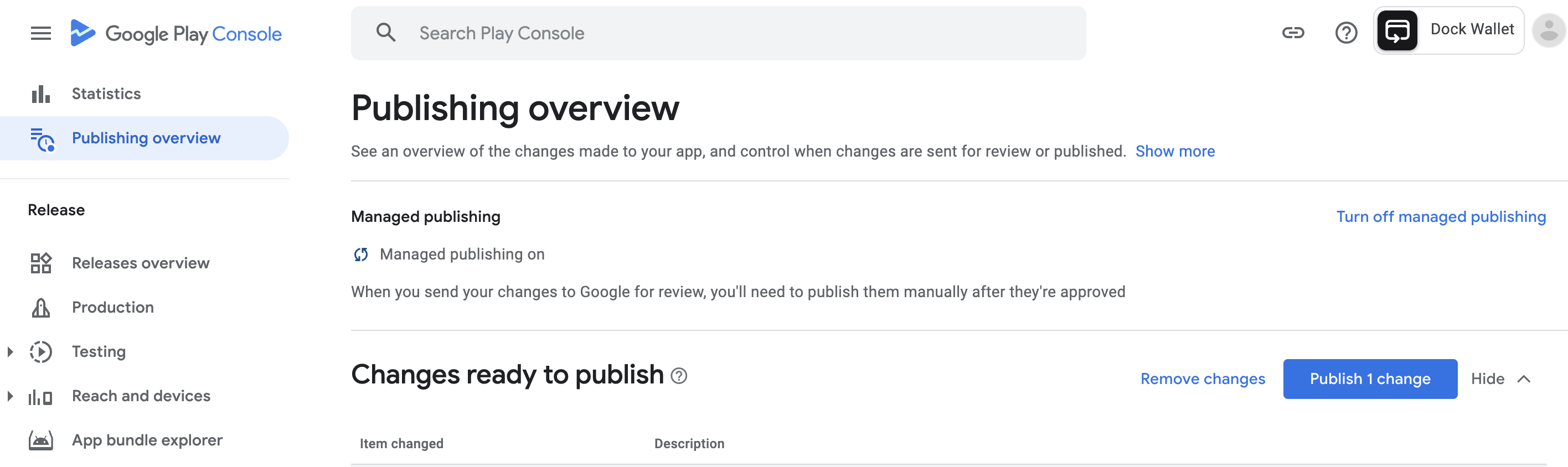
3. After the app is approved, you can publish it via Publishing Overview
---
# Agent Instructions
This documentation is published with GitBook. GitBook is the documentation platform designed so that both humans and AI agents can read, navigate, and reason over technical content effectively. Learn more at gitbook.com.
## Querying This Documentation
If you need additional information that is not directly available in this page, you can query the documentation by asking a question.
Perform an HTTP GET request on the following URL with the `ask` and `goal` query parameters:
```
GET https://docs.truvera.io/credential-wallet/white-label-wallet/publishing-in-app-stores/android-build-testing-and-publishing.md?ask=&goal=
```
`ask` is the immediate question: it should be specific, self-contained, and written in natural language.
`goal` is what the user is ultimately trying to achieve, the reason they need the answer. Sharing it helps GitBook give you a better, more relevant answer. A goal is most helpful when it describes the outcome the user wants rather than restating the question. For example, with `ask=how do I create an API token`, a goal like `automate deployments from our CI pipeline` lets GitBook tailor the answer to that use case.
The response will contain a direct answer to the question and relevant excerpts and sources from the documentation.
Use this mechanism when the answer is not explicitly present in the current page, you need clarification or additional context, or you want to retrieve related documentation sections.